The U.S. Supreme Court heard oral arguments on Monday in a highly anticipated case that could have major implications for how federal elections are conducted across the country, particularly regarding the handling of mail-in ballots that arrive after Election Day.
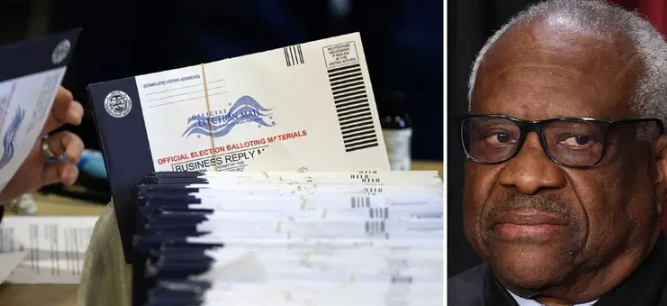
The case, Watson v. RNC, centers on a challenge to a Mississippi law that allows absentee ballots to be counted as long as they are postmarked by Election Day, even if they are received up to five days afterward. Mississippi is not alone in this practice—fourteen other states, along with the District of Columbia, have similar provisions that permit ballots to arrive after Election Day provided they were mailed on time.
At the heart of the dispute is a fundamental legal question: whether federal law establishing a single national Election Day for federal races requires that all ballots must be received by that specific date, or whether states have the authority to accept ballots that arrive later as long as they were properly cast and postmarked on time.
During the oral arguments, Justice Samuel Alito focused closely on the meaning of the term “Election Day” as written in federal statutes. He questioned whether the phrase itself implies a strict and immovable deadline for all aspects of voting, including the receipt of ballots.
Alito illustrated his point by referencing other well-known holidays and observances, such as Labor Day, Memorial Day, George Washington’s birthday, and Independence Day, noting that each refers to a specific calendar day. He suggested that, based solely on the wording, “Election Day” could reasonably be interpreted as the single day on which the essential components of an election must occur.
These remarks came as attorneys on both sides debated whether Congress, in establishing a uniform Election Day, intended to require that ballots not only be cast but also physically received by election officials by that date.
Lawyers representing the Republican National Committee argued that federal statutes clearly set one day for the selection of presidential electors and members of Congress. From their perspective, this means that all ballots must be in the possession of election authorities by the close of polls on Election Day. They contend that allowing ballots to arrive days afterward effectively extends the election period beyond what Congress authorized.
On the other side, attorneys defending Mississippi’s law maintained that states have historically been responsible for managing the practical details of election administration, including how ballots are collected and counted. They argued that setting receipt deadlines based on postmarks falls within that traditional state authority. Additionally, they highlighted real-world concerns such as mail delivery delays, especially for military personnel and overseas voters, who may face additional logistical challenges.
Under the Mississippi statute, absentee ballots must be postmarked on or before Election Day and received within five days to be counted. Other states have even longer windows; for example, Illinois allows ballots to be counted if they arrive up to 14 days after Election Day, as long as they were mailed on time.
Advocates who support stricter deadlines argue that federal law is unambiguous and that counting ballots after Election Day undermines consistency and public confidence in federal elections. Jason Snead, executive director of the Honest Elections Project, stated that Congress has already made its intent clear, asserting that ballots should be received by Election Day. He criticized states that continue to accept late-arriving ballots, saying this practice allows votes to be counted well beyond the federally established deadline.
Others point out that the use of mail-in and absentee voting expanded significantly during the COVID-19 pandemic, when many states adjusted their voting procedures to accommodate public health concerns. As a result, late-arriving ballots became more common, and some states maintained those policies even after the height of the pandemic.
The case also touches on federal protections for certain groups of voters. Congress previously passed the Uniformed and Overseas Citizens Absentee Voting Act, which requires states to send absentee ballots to military and overseas voters at least 45 days before federal elections. Attorneys defending Mississippi’s approach argue that imposing a strict receipt deadline could disadvantage these voters if postal delays prevent ballots from arriving on time, despite being mailed in compliance with the law.
Public opinion on the issue appears to be strongly engaged. A poll conducted by CRC Research on behalf of the Honest Elections Project between March 12 and March 17 surveyed 1,600 likely voters and found that 78% believe requiring ballots to be received by the end of Election Day would make elections more secure. The survey also showed strong support across party lines, including 90% of Republicans, 77% of independents, and 68% of Democrats agreeing with that position.
The Supreme Court is not expected to issue a ruling in the case until late June. Its eventual decision could provide long-awaited clarity on whether federal Election Day laws mandate that ballots must be received by that date or whether states can continue to count ballots that arrive afterward, as long as they were mailed on time. The outcome could significantly shape election procedures nationwide in future federal contests.