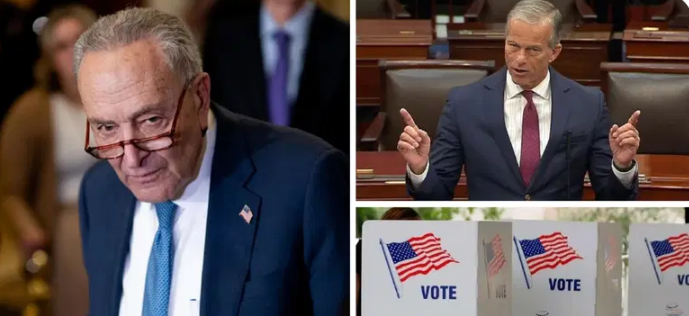
Senate Republican Leader John Thune indicated that Republicans are ready to consider more assertive legislative strategies to secure passage of the SAVE America Act. He emphasized that budget reconciliation remains a practical and potentially necessary option if Democratic resistance continues to block the bill’s progress.
Thune explained that while reconciliation is not always the first choice, it becomes appropriate when there is sufficient justification. He suggested that such justification may indeed exist in this case, noting that the topic was recently discussed among Republican senators during a closed-door luncheon. According to Thune, there appears to be growing support within the conference for pursuing a reconciliation bill if it helps move key priorities forward.
He also pointed out that Republicans are not limited to a single path. Instead, they have multiple legislative tools at their disposal to advance the measure. Leadership, he said, is fully prepared to explore and potentially deploy those options if it increases the likelihood of the bill ultimately being passed. Thune stressed that if using one of these mechanisms allows Republicans to push the legislation across the finish line with a simple majority, it is something they will seriously evaluate.
Under the budget reconciliation process, legislation can pass the Senate with a simple majority vote, bypassing the usual 60-vote threshold required to overcome a filibuster. This means Republicans could approve the measure with just 50 votes, with Vice President JD Vance available to cast a tie-breaking vote if necessary. However, reconciliation comes with strict limitations. The Byrd Rule restricts what can be included, allowing only provisions that directly impact federal spending or revenue. Any components deemed unrelated—or “extraneous”—can be challenged and stripped from the bill.
Senator John Kennedy also expressed strong support for using reconciliation as a pathway forward. He encouraged Republicans to make full use of every legal and procedural avenue available to ensure the legislation complies with Senate rules while still achieving its objectives. Kennedy reiterated that reconciliation would allow the bill to pass with Republican votes alone, supplemented by the vice president if needed.
Meanwhile, Markwayne Mullin, who was recently appointed as Secretary of the Department of Homeland Security, suggested that internal discussions about this strategy are already in motion. He noted that Republican leadership is actively working behind the scenes to develop a viable reconciliation framework. In particular, he highlighted the role of Lindsey Graham, who is expected to play a key part in shaping how reconciliation would be used to move the legislation forward.
Mullin explained that this framework could potentially include funding measures related to immigration enforcement, such as additional resources for ICE, as well as financial adjustments tied to broader legislative packages. More importantly, he emphasized that the SAVE America Act itself could be structured in a way that meets reconciliation requirements by incorporating policies with clear budgetary implications.
He further argued that the bill addresses a priority issue for many Americans—election integrity. Citing public opinion, Mullin claimed that a significant majority of voters support ensuring that only eligible citizens participate in elections. He framed the SAVE America Act as a response to those concerns, suggesting it aligns with widespread calls for stricter safeguards in the voting process.
Mullin concluded by expressing confidence that, with Graham’s involvement and leadership commitment, Republicans have a realistic path to advancing the legislation through reconciliation if other routes remain blocked.