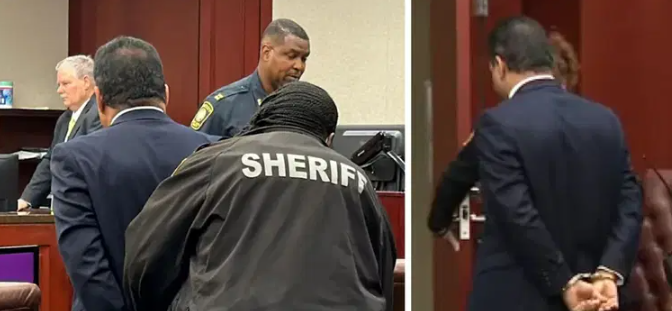
A jury in Fort Bend County has found County Judge KP George guilty on two counts of money laundering, charges that could result in a prison sentence ranging from two to ten years. Rather than having a jury determine his punishment, George has opted for the judge to decide his sentencing.
The punishment phase of the trial is scheduled to begin on June 16, following an agreement between prosecutors and the defense. After the verdict was delivered, George was released from custody on a $20,000 bond—set at $10,000 for each count—and was required to surrender his U.S. passport as part of the conditions of his release.
Under Texas law, George will be removed from his position as county judge following his conviction; however, this removal will not take effect until after he has been formally sentenced. In the meantime, Fort Bend County commissioners may choose to redistribute his responsibilities among themselves or appoint an interim replacement to fulfill his duties.
Precinct 4 Commissioner Dexter McCoy stated that the commissioners plan to meet on Thursday to discuss and decide the next steps regarding the county’s leadership. After being released on bond, George exited the Fort Bend County Jail at approximately 8 p.m. on Friday evening.
The trial concluded its closing arguments on Thursday, with George choosing not to testify in his own defense throughout the proceedings. Prior to closing statements, the judge carefully reviewed the legal instructions with the jury, including the specific charges and the standards required to reach a verdict.
Although George initially pleaded not guilty to the allegations, jurors were given the option to consider a lesser charge of a state jail felony or to convict him on the more serious third-degree felony counts. The judge also explained the legal definition of money laundering and outlined the criteria jurors needed to evaluate during their deliberations.
During closing arguments, prosecutors emphasized what they described as a consistent pattern of misrepresentation involving campaign finances. Assistant District Attorney Katherine Peterson argued that George repeatedly submitted inaccurate campaign finance reports and used campaign funds for personal benefit.
Prosecutors highlighted several key points, including allegations that George transferred campaign money into his personal bank accounts, used those funds for expenses such as car payments and other personal costs, and engaged in financial transactions involving out-of-state entities, including accounts linked to Delaware and communications tied to Massachusetts.
They further argued that George anticipated receiving campaign contributions by opening a personal savings account after a 2019 fundraiser, suggesting premeditated intent. Peterson stressed that candidates are legally required to maintain transparency and accurately report all financial activity, referencing testimony from a Texas Ethics Commission representative.
According to the prosecution, the evidence showed that George improperly retained more campaign money than he was entitled to and used it for personal expenses over an extended period. They rejected any claims that the case was politically motivated, asserting instead that it was about accountability and financial integrity.
In response, the defense argued that the prosecution’s case was built on incomplete evidence and flawed assumptions. George’s attorneys maintained that the situation reflected government overreach rather than criminal wrongdoing. They insisted that the state failed to prove intent to commit fraud—an essential element for a conviction—and argued there was no definitive proof that George knowingly used funds illegally.
The defense also pointed out that candidates are permitted under Texas Ethics Commission rules to loan money to their campaigns and later reimburse themselves. They questioned how certain transactions, particularly credit card expenses, were categorized, arguing that without detailed documentation, it was difficult to distinguish between personal and campaign-related spending.
Additionally, George’s legal team contended that there was no attempt to conceal financial activity, noting that the transactions in question were conducted through accounts in his own name. They argued this demonstrated transparency rather than deception.
Defense attorneys further claimed that the investigation overlooked key information and ultimately failed to prove that a crime had occurred. However, prosecutors countered with court documents alleging that George had lied under oath about the balance of his campaign accounts and had transferred funds into personal accounts improperly.
They also alleged that George engaged in a scheme to mislead campaign donors and obtain money under false pretenses. According to the state, he accepted thousands of dollars in contributions and then used those funds for personal enrichment, forming the basis of the charges that ultimately led to his conviction.