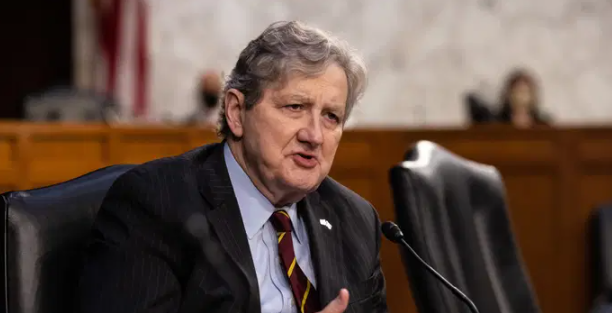
Sen. John Kennedy is encouraging fellow Republicans to consider a significant procedural shift in order to pass the SAVE America Act — specifically by using the budget reconciliation process to sidestep a potential Democratic filibuster and approve the legislation with a simple majority vote.
At present, Senate Majority Leader John Thune plans to bring the SAVE America Act to the floor under standard legislative procedures. That path would require 60 votes to invoke cloture and overcome a filibuster. Given that Republicans currently hold 53 seats in the Senate, they would need at least seven Democrats to cross party lines and support the measure — a scenario many see as unlikely.
Kennedy, however, argues that pursuing bipartisan support through the traditional process may not be necessary. Speaking on the Senate floor, he suggested that Republicans instead attempt to pass the bill through reconciliation — a process established under the Congressional Budget Act of 1974. This mechanism allows certain types of budget-related legislation to pass with a simple majority of 50 votes, plus a tie-breaking vote from the vice president. In this case, that could mean passage with unified Republican support and a deciding vote from Vice President JD Vance.
“That’s how we passed the one big, beautiful bill,” Kennedy said, referencing previous Republican efforts that were enacted without Democratic backing. He also pointed out that Democrats used reconciliation in 2021 to pass the $1.9 trillion American Rescue Plan along party lines.
Still, Kennedy acknowledged that using reconciliation is not without challenges. One key requirement is that provisions included in such a bill must have a direct impact on federal spending, revenue, or the national debt. Additionally, any measure must comply with the Budget Control Act and undergo scrutiny under the so-called Byrd Rule — a guideline that restricts “extraneous” provisions whose budgetary effects are merely incidental to broader policy changes.
“We call that giving a provision a Byrd bath,” Kennedy explained, referring to the process by which the Senate parliamentarian evaluates whether parts of a bill meet reconciliation standards.
The Senate parliamentarian plays a critical role in this process, determining which provisions are permissible under reconciliation rules and which must be removed. Kennedy urged Republican leadership to work closely with legal and legislative experts to draft a version of the SAVE America Act that could withstand this scrutiny.
“We have yet to try going to these smart lawyers … and saying, ‘Craft us a SAVE Act that will pass muster under the Budget Control Act and can be blessed by the parliamentarian,’” he said.
Some lawmakers have expressed doubts that the bill’s election-related provisions would qualify under reconciliation rules, particularly because they are primarily policy-driven rather than budget-focused. Kennedy, however, dismissed this skepticism, noting that outcomes under the Byrd Rule can be unpredictable.
“I’ve been here 10 years. I’ve seen things pass muster — survive a Byrd bath — that I didn’t think had a chance,” he said. “And I’ve seen provisions fail that I thought were sure bets. You don’t know until you try.”
The SAVE America Act, which has the backing of President Donald Trump, includes several election-related reforms. Among its provisions are requirements for proof of U.S. citizenship when registering to vote in federal elections, mandatory photo identification at polling locations, and stricter limitations on mail-in voting — restricting it primarily to situations such as military service, illness, disability, or travel.
Supporters of the bill argue that these measures are necessary to restore public confidence in the integrity of U.S. elections. Critics, however, counter that instances of non-citizen voting are extremely rare and warn that such requirements could create barriers for eligible voters, particularly those who may lack easy access to documentation.
Frustration has been growing among Republican activists and lawmakers as the bill faces procedural obstacles. In a separate legislative effort last year, when the Senate parliamentarian rejected a Medicaid-related provision in a GOP proposal, some conservatives voiced concern about the influence of an unelected official over the legislative process.
Kennedy stopped short of advocating for changes to Senate rules or the removal of the parliamentarian. Instead, he emphasized that Republicans should fully explore the reconciliation option before abandoning it.
“If this bill is as important as many believe it is — and I think it is, because we’re talking about public trust in our elections — then we should at least attempt to move it through reconciliation,” he said.
Whether Senate leadership ultimately adopts Kennedy’s approach remains uncertain. However, his comments highlight increasing pressure within the Republican conference to use every procedural tool available to advance their election policy priorities — even if doing so requires redefining the traditional legislative strategy in the Senate.