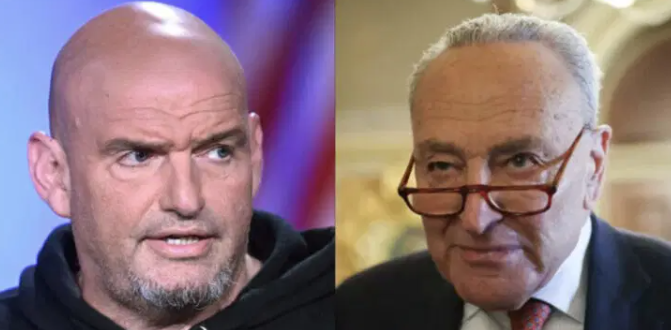
Senator John Fetterman told Jesse Watters during a Thursday evening interview that, in his view, much of the American media has been “carrying water” for Iran. He suggested this tendency may be driven, at least in part, by opposition to President Donald Trump, though he stopped short of directly criticizing members of his own Democratic Party for similar behavior.
Watters posed a pointed question, asking whether some Democrats might see Trump as a greater threat than Iran. The question reflects ongoing political debate surrounding criticism of the administration’s stance toward the Iranian government, a regime long accused by both Democrats and Republicans of supporting terrorism and pursuing nuclear weapons capabilities.
Fetterman responded by clarifying that he could not speak for his fellow Democrats but sharply criticized the broader media landscape. He argued that coverage often highlights certain narratives while overlooking Iran’s historical and ongoing actions. According to Fetterman, there is a reluctance in some media circles to plainly describe Iran’s behavior and hold it accountable.
He went on to emphasize his belief that the United States plays a positive role globally and that confronting Iran over its actions is both justified and necessary. His remarks reflected a more hawkish tone than that of many in his party, particularly on matters involving military engagement and foreign policy.
Fetterman’s comments follow a tense exchange he had last month with CNN host Kaitlan Collins during an appearance on The Source. The discussion took place amid fallout from a February 28 U.S. military strike involving Tomahawk missiles in southeastern Iran. The strike reportedly hit a building associated with the Shajarah Tayyebeh elementary school in the city of Minab.
Iranian sources claimed that at least 175 people were killed in the attack, with many of the victims reportedly being children. A preliminary U.S. military review later indicated that the strike was the result of faulty targeting intelligence, allegedly based on outdated information provided by the Defense Intelligence Agency. The intended target was said to be a nearby Iranian military installation, not the school itself.
In response to the incident, nearly every Senate Democrat signed a letter addressed to Defense Secretary Pete Hegseth, calling for a swift and thorough investigation into the strike. Notably, Fetterman was the only Democrat who chose not to sign the letter.
During the CNN interview, Collins questioned him directly about his decision. She pointed out that all of his Democratic colleagues in the Senate had supported the request for an investigation and asked why he had declined to join them.
Fetterman acknowledged that the strike was a tragedy and stated that he supported efforts to investigate what happened and ensure accountability. However, he also expressed disagreement with what he characterized as broader criticism from fellow Democrats, particularly claims that the conflict represented a “war of choice” or was fundamentally misguided.
He made clear that, in his view, the military action itself was justified and that he stood behind it, even while recognizing the seriousness of the unintended civilian casualties. He also noted that the Pentagon had already indicated responsibility might lie with the U.S. and suggested that an apology would be appropriate if the investigation confirms those findings.
At the same time, Fetterman shifted focus to what he يرى as an imbalance in media coverage. He argued that the response to the school strike, while understandable given its tragic nature, has been disproportionately intense compared to coverage of actions taken by Iran.
Fetterman stated that the United States does not intentionally target civilians, contrasting this with his characterization of Iran’s conduct. He claimed that Iran has been responsible for large-scale violence against its own population, asserting that such actions have not received the same level of sustained attention or outrage in parts of the media.
As Collins attempted to interject during the interview, Fetterman continued speaking forcefully, reiterating his belief that media outlets have focused heavily on U.S. missteps while underreporting or downplaying violence attributed to Iran.
Collins pushed back on this assertion, noting that CNN and other outlets had provided significant coverage of protests and internal unrest within Iran. In response, Fetterman said he does not regularly watch CNN and clarified that his criticism was aimed more broadly at what he described as “left-leaning media.”
He specifically mentioned outlets such as The New York Times, suggesting that their reporting often frames U.S. military actions in a negative light and portrays broader war efforts as failures.
Overall, Fetterman’s remarks highlight ongoing divisions within American political discourse over foreign policy, media coverage, and how the United States should respond to adversarial nations like Iran.