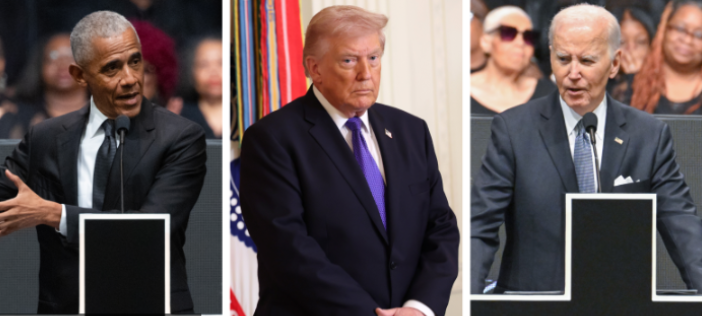
Former Presidents Joe Biden, Barack Obama, and Bill Clinton attended the funeral of the late civil rights icon Jesse Jackson on Friday. During the service, Obama and Biden, joined by Vice President Kamala Harris, made pointed remarks critical of President Donald Trump, drawing sharp criticism from Jackson’s son.
At one point during her speech, Harris commented, “Let me just tell you, I predicted a lot of what’s happening right now.” She added, in a Southern-style accent, “I’m not into saying ‘I told you so,’ but we did see it coming,” clearly referencing the policies and actions of the Trump administration. Obama made similar remarks during his address, speaking in an accent that seemed to resonate with the audience.
The political nature of these comments did not go unnoticed by Jackson’s family. Jesse Jackson Jr., a former Democratic congressman from Illinois and son of the late civil rights leader, publicly criticized the former leaders’ approach. He emphasized that the occasion was meant to honor his father’s legacy, not serve as a platform for political commentary. “Do not bring your politics out of respect for Rev. Jesse Jackson and the life he lived,” Jackson Jr. said. “Come respectfully, and come to say thank you. These services are open to all—Democrat, Republican, liberal, conservative, right-wing, left-wing—because his life represented the full spectrum of what it means to be an American.”
Other notable figures at the service included Hillary Clinton and Jill Biden, though former First Lady Michelle Obama was absent.
Meanwhile, the remarks by Harris, Obama, and Biden have drawn additional criticism in the broader political context. A resurfaced video of former House Speaker Nancy Pelosi defending Obama’s 2011 military strikes in Libya without seeking formal congressional authorization has regained attention. During a 2011 press briefing, a reporter asked Pelosi whether President Obama needed congressional approval for the operation. She responded affirmatively that he did not, a stance that contrasts sharply with her criticism of Trump’s recent military strikes against Iran.
Regarding the Iran strikes, Pelosi wrote on X, “President Trump’s decision to initiate military hostilities in Iran starts another unnecessary war, endangering our servicemembers and destabilizing an already fragile region. The Constitution is clear: decisions that lead our nation into war must be authorized by Congress,” referencing the 1973 War Powers Act. Pelosi’s office has argued that the two situations—Libya in 2011 and Iran under Trump—are fundamentally different, although critics say this distinction is misleading.
A spokesperson for Pelosi, Ian Krager, said, “There is an absolute distinction between the limited military operations in Libya and the broad, escalating conflict with Iran initiated by President Trump. Speaker Pelosi’s position has been consistent: when expansive or prolonged hostilities are possible, Congress must provide authorization.”
The Trump administration, for its part, defended the operation as a necessary measure to prevent Iran from acquiring nuclear weapons. The strikes targeted Iranian military leadership, including Supreme Leader Ali Khamenei and other senior officials, in coordination with Israeli forces.
The controversy has reignited debate over Obama’s 2011 intervention in Libya, known as Operation Odyssey Dawn, when the U.S. and NATO conducted airstrikes against Libyan government forces to stop Muammar Gaddafi from attacking civilian protesters during the Libyan uprising. Obama consulted congressional leaders beforehand but did not seek a formal declaration of war, similar to debates surrounding Trump’s Iran strikes.
Pelosi and other Democrats are now pursuing a War Powers resolution aimed at limiting Trump’s ability to conduct further military operations against Iran without explicit congressional authorization, though efforts to invoke it failed in Congress this week. Historically, both Republican and Democratic administrations have viewed the War Powers Act as an unconstitutional constraint on the president’s authority as commander-in-chief.