The SAVE America Act (H.R. 22) would require individuals to provide documentary proof of United States citizenship when registering to vote in federal elections. Acceptable forms of proof would include documents such as a U.S. passport, a birth certificate, or other official records confirming citizenship status. In addition to this requirement, the legislation would mandate that voters present a government-issued photo identification when casting ballots in person. The bill would also instruct states to verify their voter registration lists against federal databases in order to ensure that only U.S. citizens are included on the rolls.
President Donald Trump has identified the bill as one of his top legislative priorities, arguing that stronger election safeguards are essential for maintaining public confidence in the electoral system. Speaking at a recent Republican event in Miami, Trump emphasized the importance of stricter verification standards. “All voters must show proof of citizenship in order to vote,” he said during the event.
Trump later reiterated his position on Truth Social, where he urged Congress to move quickly on the legislation. In the post, he stated that the measure “must be done immediately” and suggested he could refuse to sign other bills until lawmakers send the SAVE America Act to his desk for approval. “MUST GO TO THE FRONT OF THE LINE… GO FOR THE GOLD,” he wrote, signaling the high level of priority he places on the proposal.
Polling data has consistently indicated strong public support for voter identification requirements across a wide range of political and demographic groups. According to surveys conducted by the Pew Research Center, approximately 83 percent of Americans support requiring voters to present a government-issued photo ID in order to vote. That support includes about 95 percent of Republicans and 71 percent of Democrats. Similar results have been found in Gallup polling, which shows that 84 percent of Americans support photo ID requirements for voting. The same Gallup data also indicates that roughly 83 percent of respondents favor requiring proof of citizenship when registering to vote for the first time.
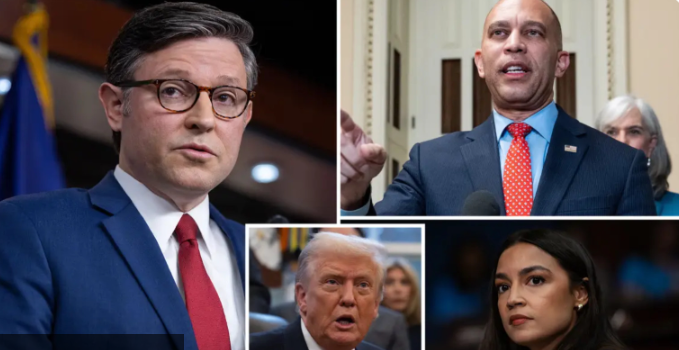
Earlier this year, the U.S. House of Representatives approved the Safeguard American Voter Eligibility (SAVE) America Act in February with a narrow vote of 218–213. The measure received support almost entirely from Republican lawmakers. Only one House Democrat voted in favor of the bill, meaning that roughly 99.5 percent of Democrats in the chamber opposed the legislation despite polling that suggests strong national support for voter identification requirements.
Some political analysts have pointed out that voter ID policies appear to have broad backing among the public. CNN data analyst Harry Enten commented that voter identification “is NOT controversial in this country,” noting that majorities across racial, political, and demographic groups support such requirements. NBC News anchor Tom Llamas has also observed that while public opinion polls show strong approval for voter ID policies, many Democratic members of Congress remain opposed to the legislation.
Despite the widespread support indicated by polling data, Senate Minority Leader Chuck Schumer has strongly criticized the SAVE America Act as it advances toward consideration in the Senate. Schumer argues that the legislation could have broader consequences than simply requiring identification at the polls.
“This is about voter registration,” Schumer said while explaining his opposition to the bill. He argued that the measure could allow Immigration and Customs Enforcement (ICE) to remove large numbers of individuals from voter registration lists. According to Schumer, those individuals might not be notified of the change until Election Day. “It allows ICE to kick tens of millions of people off the rolls… And they don’t tell them until Election Day,” he said.
Schumer went further in his criticism, describing the proposal in stark terms. “This is a bill that destroys the country,” he said. “It is not about showing ID when you show up to vote. It’s about the voter registration rolls, destroying them, purging them.”
Republican lawmakers and supporters of the legislation strongly dispute those claims. They argue that the SAVE America Act is intended to enforce existing federal law, which already restricts participation in federal elections to U.S. citizens. According to supporters, the bill simply strengthens procedures designed to ensure that non-citizens are not mistakenly registered or allowed to vote in federal contests.
Under the proposed legislation, proof of citizenship would be required during the voter registration process, and states would be required to conduct more thorough checks of their voter rolls. Supporters emphasize that the bill does not eliminate voting rights for eligible citizens and instead focuses on preventing ineligible individuals from being included in the system.
Backers of the bill frequently describe it as a “commonsense” measure aimed at protecting election integrity. They note that showing identification is already required in many everyday situations, such as boarding airplanes, purchasing certain restricted goods, or completing financial transactions. From their perspective, requiring identification for voting is a reasonable step to ensure confidence in election outcomes.
The legislation now faces a much more difficult path in the Senate. Under current Senate rules, most legislation requires at least 60 votes to overcome a filibuster and proceed to a final vote. Because Democrats hold enough seats to block the bill if they remain united in opposition, the SAVE America Act’s chances of passage remain uncertain unless some level of bipartisan agreement can be reached.
Trump has also framed the debate around the bill in both policy and political terms. He has argued that implementing strict voter verification standards could significantly change the electoral landscape in the United States. According to Trump, enforcing proof-of-citizenship requirements nationwide would alter the balance of future elections. He has claimed that if such measures were fully implemented, Democrats “probably won’t win an election for 50 years.”
As the next round of midterm elections approaches, the SAVE America Act has become one of the most debated and controversial legislative proposals in Washington. The contrast between strong public support in national polls and the near-unanimous opposition from Democratic lawmakers in Congress is expected to remain a central point of discussion as the debate continues in the Senate. Whether the legislation ultimately advances or stalls will likely depend on whether lawmakers can bridge the deep political divide surrounding election policy and voting requirements.