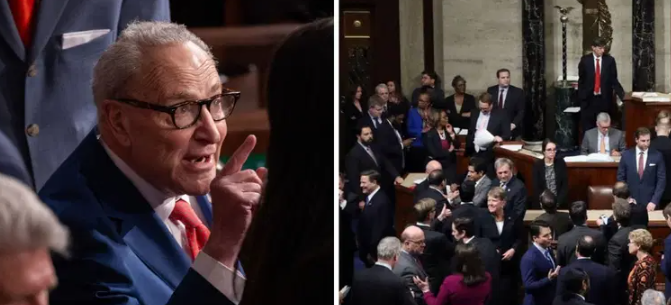
The GOP-controlled Senate voted by a narrow margin on Tuesday to advance the SAVE America Act, setting the stage for what is expected to be a lengthy and contentious debate that could stretch on for several days. The procedural vote passed 51–48, with unified opposition from Democrats and a small number of Republicans joining them in voting against the measure, despite claims that the proposal enjoys broad support among voters from both major political parties.
Senate Majority Leader John Thune (R-S.D.) is expected to introduce multiple amendments during the debate process. These amendments may break out key components of the broader legislation into separate votes. Among the provisions likely to be considered are measures to significantly restrict mail-in voting, require voter identification for participation in all federal elections, and mandate that school sports teams be limited to participation based on biological sex assigned at birth.
Republicans in the Senate, who are preparing for what is anticipated to be a highly competitive midterm election cycle, appear poised to use the expected failure of the legislation as a political weapon. The bill has become a priority for President Donald Trump, and GOP lawmakers are aiming to highlight Democratic opposition to it as part of their broader campaign messaging.
The Safeguard American Voter Eligibility (SAVE) Act would require individuals to provide proof of U.S. citizenship when registering to vote, as well as present a valid photo ID when casting a ballot. However, the measure faces significant obstacles in the Senate, where Republicans lack the 60 votes necessary to overcome a filibuster in the evenly divided 100-member chamber.
With Democrats expected to unanimously block the bill, Republican senators have initiated an extended floor debate. Their goal is to draw public attention to Democratic resistance to voter ID laws and related election security measures.
According to reporting by The Detroit News, public opinion polls indicate widespread support for voter identification requirements across a broad spectrum of voters, including both Republicans and Democrats. GOP leaders have emphasized this point as they seek to frame the issue politically.
“We’re going to put every one of them on the record so that everyone in America knows that Republicans support voter ID and Democrats are the party of open borders and illegal voters,” said Sen. John Barrasso of Wyoming, the Senate’s No. 2 Republican, in remarks to reporters.
Democrats, meanwhile, argue that such voter ID requirements could disenfranchise large numbers of eligible voters, particularly women and minority groups. This argument has been a consistent point of opposition to Republican-backed election reforms. Some Democratic lawmakers and advocates have gone further, describing the SAVE America Act as “Jim Crow 2.0,” a comparison intended to highlight concerns about potential voter suppression.
Republicans have rejected these claims, countering that the legislation is designed to ensure election integrity and public confidence in the voting process. They also argue that Democrats’ criticisms are politically motivated and not supported by evidence.
Additionally, Democrats have accused former President Trump of supporting the legislation as a way to tilt future elections in favor of Republicans. They argue that election administration should remain independent and free from partisan influence.
“Fundamentally, these are the American people’s elections,” said Rep. Joe Morelle, the top Democrat on the House Administration Committee, which oversees election matters. “They’re not Donald Trump’s. They’re not the Republican Party’s. They’re not the Democratic Party’s.”
Morelle added that if voters come to believe that political leaders are attempting to interfere with election officials or disrupt their work, there could be significant public backlash.
Democrats frequently maintain that instances of voter fraud in the United States are rare. However, Republicans point to cases identified by federal law enforcement agencies, including the FBI, as evidence that vulnerabilities still exist within the system.
FBI Director Kash Patel stated last summer that, under his predecessor, the bureau halted an investigation into alleged Chinese interference in the lead-up to the 2024 election. According to Patel, the alleged scheme involved the Chinese government supplying fraudulent driver’s licenses to Chinese nationals residing in the United States, enabling them to vote in support of Joe Biden and later Kamala Harris.
Following the 2020 election, Trump and his allies claimed that widespread fraud had occurred, particularly due to the expanded use of mail-in ballots, which they argued lacked sufficient oversight. These claims were strongly disputed by Democrats and many election officials.
However, in December, the Fulton County Election Board in Georgia—covering the Atlanta area—acknowledged that approximately 315,000 ballots had been improperly certified. The issue stemmed from missing required signatures on tabulator tapes completed by poll workers.
Fulton County Commission Chairman Robb Pitts released documentation related to the discrepancy and acknowledged the error, stating that the county had “nothing to hide.” He also noted that the state elections board had spent over a year attempting unsuccessfully to obtain the same information.
In the 2020 presidential election, Trump lost the state of Georgia to Biden by a margin of just 11,779 votes, further intensifying ongoing debates about election procedures and integrity.