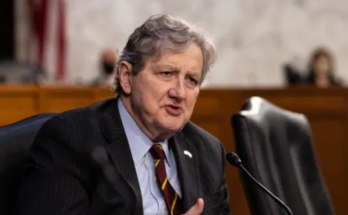
Maj. Gen. John L. Rafferty Jr. has been officially confirmed by the U.S. Senate for promotion to the rank of lieutenant general, along with his new assignment as the commanding general of the U.S. Army Space and Missile Defense Command. This advancement marks a significant milestone in Rafferty’s long military career, reflecting decades of service and leadership within the Army.
Rafferty is currently serving as chief of staff at the U.S. European Command, based in Germany. Over the course of more than 33 years in uniform, he has developed extensive experience in both leadership and technical roles, with particular expertise in field artillery operations as well as high-level command and staff assignments.
Throughout his career, Rafferty has held a number of prominent leadership positions. His recent assignments include serving as commanding general of the 56th Artillery Command within U.S. Army Europe-Africa in Germany, as well as chief of Army Public Affairs in Washington, D.C. He also led the Long Range Precision Fires Cross Functional Team at Fort Sill, Oklahoma, and previously worked as executive officer to the director of the Army Staff in Washington. In addition, he commanded the 18th Field Artillery Brigade at Fort Bragg, further demonstrating his depth of operational and leadership experience.
Rafferty has also contributed to a number of major U.S. military operations over the years, including Operation Enduring Freedom, Operation Iraqi Freedom, Operation Spartan Shield, and Operation Inherent Resolve, among others. His involvement in these missions underscores his broad operational background and experience in complex global environments.
He will succeed Lt. Gen. Sean A. Gainey, who is retiring after more than 35 years of distinguished service in the military.
In a broader context, Senate Republicans have recently confirmed nearly 100 of Donald Trump’s nominees, surpassing the pace seen in previous administrations, including Trump’s own first term. A vote of 53–43 on Thursday approved 97 of the president’s selections, marking some of the final legislative activity on the Senate floor following an intense and fast-paced period.
This accelerated push was led by Senate Majority Leader John Thune after Republicans gained control of the chamber in January. During this time, Republicans managed to overcome internal disagreements to pass what Trump has referred to as his signature “one big, beautiful bill.” They also took action to reopen the federal government after what was described as the longest shutdown in U.S. history, according to reporting from Fox News.
Despite these legislative accomplishments, confirming nominees proved to be a challenging process under Senate rules. Democrats frequently objected to nominations, including those for lower-level positions, effectively slowing the confirmation process across multiple federal agencies.
Senate Majority Whip John Barrasso noted that Republicans began the year by confirming Trump’s Cabinet nominees at a historically rapid pace. However, he said that effort soon encountered what he described as “unprecedented obstruction” from the Democratic minority in the Senate.
Barrasso stated that by the end of the week, Trump would have 417 nominees confirmed by the Senate within the year—a figure significantly higher than the 365 confirmations achieved during the first year of Joe Biden’s administration.
In response to the slowdown, Republicans invoked what is commonly referred to as the “nuclear option” in September, lowering the threshold required to confirm sub-Cabinet nominees. Since implementing this change, the Senate has moved forward with confirming a total of 417 of Trump’s appointees.
Thune has accused Senate Democrats, led by Minority Leader Chuck Schumer, of engaging in what he characterized as purely political obstruction. According to Thune, Democrats have blocked routine procedures—such as unanimous consent agreements and voice votes—that are typically used to quickly advance noncontroversial nominations.
He argued that this behavior reflects frustration among Democrats over the outcome of the election, suggesting that their actions are motivated by political grievances rather than procedural concerns.
With this latest round of confirmations, Senate Republicans have nearly eliminated a backlog of pending nominations that had grown to approximately 150 candidates over the summer. At this point, only about 15 nominees remain awaiting confirmation.
Among those recently confirmed are former Rep. Anthony D’Esposito, who has been selected to serve as inspector general at the Department of Labor, as well as James Murphy and Scott Mayer, both of whom have been appointed to positions on the National Labor Relations Board. These confirmations are part of a broader effort to fill roles across nearly every major federal agency.
Senators are also expected to consider the nomination of Joshua Simmons before the end of the week, continuing the push to finalize key appointments.
At the same time, lawmakers are working to advance a large and complex spending package that combines five separate appropriations bills into a single legislative measure, often referred to as a “minibus.” However, some Democrats have raised objections to the proposal, creating uncertainty about whether it will reach the Senate floor before the end of the month.
Negotiations between Republicans and Democrats are ongoing, with Thune indicating that the immediate focus remains on clearing the remaining nominations. As he entered the Senate chamber, he suggested that once that task is completed, lawmakers would then determine how to proceed with other legislative priorities.
“We’ll see where it goes from there,” Thune said, signaling that discussions are still evolving as the Senate moves forward.