Senate Minority Leader Chuck Schumer recently drew criticism after delivering remarks about Immigration and Customs Enforcement (ICE) that some viewed as overly alarmist. Speaking on the Senate floor earlier this week, Schumer warned that deploying ICE agents to assist at airports—following a decision by former President Donald Trump—would likely result in “trouble.”
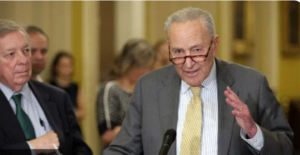
“Everywhere ICE goes, trouble follows,” Schumer stated. “We’ve seen that before, and it is highly likely airports will not be an exception.” However, in practice, ICE agents were sent to 13 airports earlier in the week and reportedly carried out their assignments without any major incidents. Their presence was intended to support Transportation Security Administration (TSA) personnel by taking over more routine responsibilities, such as monitoring exits, allowing TSA officers to concentrate on screening passengers and improving efficiency.
Schumer went on to argue that the continued presence of ICE agents in airports could remind the public of what he described as the “chaos and fear” associated with the agency’s past actions. He characterized the move as a poor decision that could ultimately have negative political consequences for Trump.
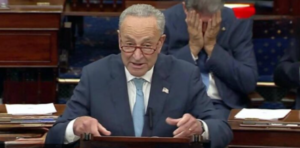
Other Democratic lawmakers echoed concerns, with some suggesting that ICE agents might replace TSA officers in managing airport security lines. In reality, ICE personnel were not assigned to conduct screenings but rather to assist in less critical roles, helping to ease the workload of TSA staff.
Shortly after Schumer’s remarks, local media reports indicated that wait times at several of the affected airports had significantly improved. For example, a reporter from WPVI-TV in Philadelphia noted during a live broadcast that security lines had virtually disappeared compared to the previous day, when they had stretched back toward parking areas. While the report did not explicitly attribute the improvement to ICE’s involvement, the timing coincided with their deployment.
Despite these developments, some travelers interviewed expressed discomfort with the presence of ICE agents in airports. Nevertheless, the noticeable reduction in wait times was not disputed.
At the same time, Senate Democrats have continued to oppose funding measures for agencies within the Department of Homeland Security, including the TSA and Coast Guard, largely due to disagreements over immigration enforcement policies. As a result of the ongoing funding impasse, many TSA employees have reportedly gone weeks without pay, leading to staffing challenges as some workers have chosen to leave their positions.
Republicans, for their part, have resisted eliminating the filibuster, which would allow legislation to pass with a simple majority. Instead, attention has turned to alternative strategies for advancing key bills.
One such proposal comes from Senator John Kennedy of Louisiana, who has suggested using the budget reconciliation process to pass the SAVE America Act. Under normal circumstances, the bill would require 60 votes in the Senate to overcome a filibuster, meaning Republican leaders would need support from several Democrats. However, reconciliation allows certain budget-related legislation to pass with a simple majority—51 votes, or 50 plus the vice president’s tie-breaking vote.
Kennedy argued that this approach could enable Republicans to move the bill forward without Democratic backing, provided it is structured to meet reconciliation rules. He pointed out that both parties have used this process in the past to pass significant legislation along party lines, including major spending bills.
Still, he acknowledged that reconciliation comes with strict requirements. Any provisions included in such a bill must directly affect federal spending or revenue, and the overall package must comply with budgetary rules. Kennedy expressed confidence that these challenges could be addressed, stating that lawmakers could identify funding sources and ensure the proposal meets the necessary guidelines.