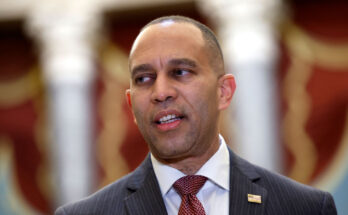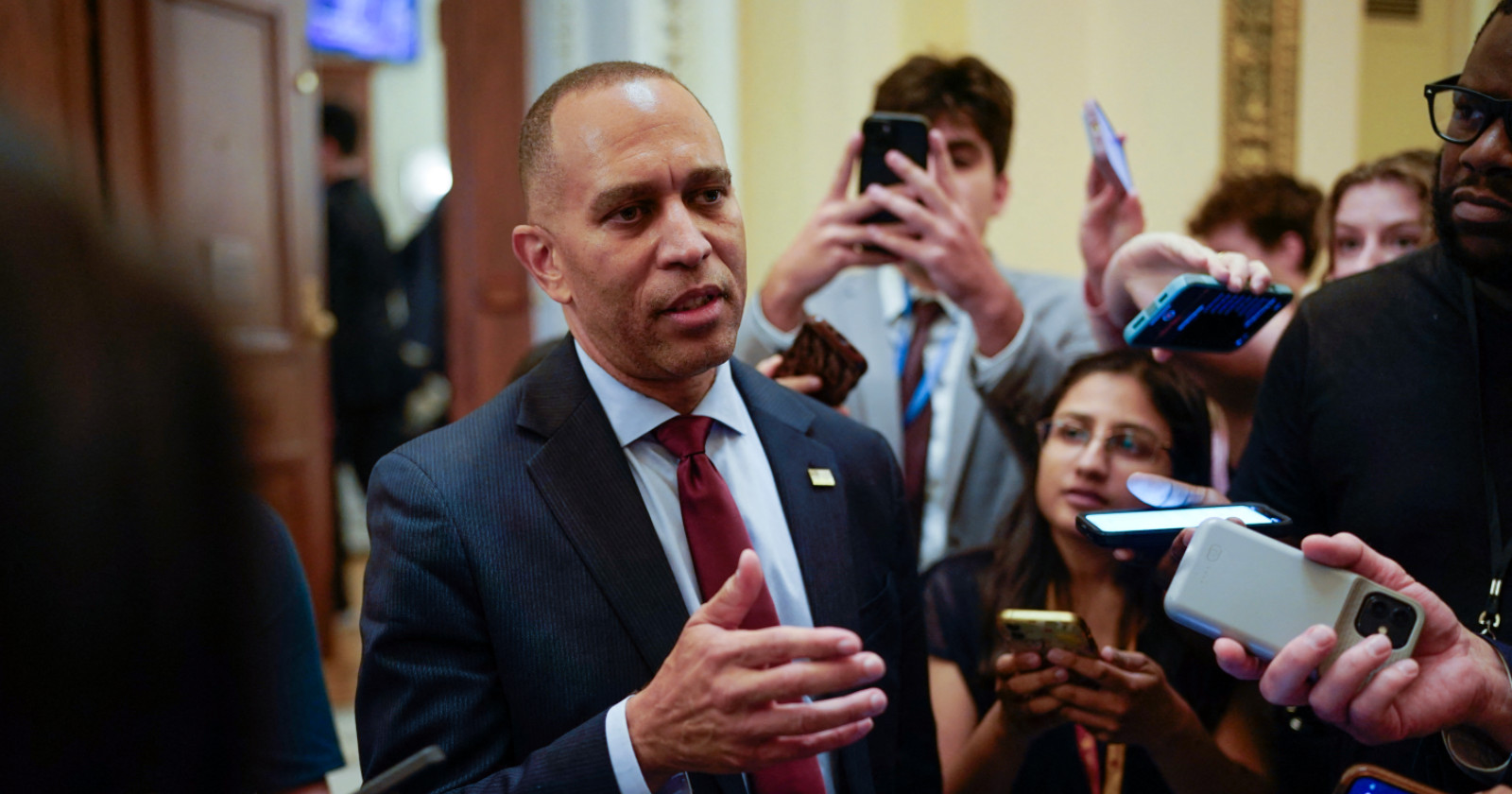
House Minority Leader Hakeem Jeffries is facing renewed criticism after a series of political setbacks and strategic mistakes that have led to costly Democratic losses at a time when Republicans continue strengthening their advantages in fundraising and congressional redistricting.
One of the most controversial setbacks involved a Jeffries-backed effort to redraw Virginia’s congressional map in a way that would have dramatically favored Democrats. The proposed changes aimed to shift the state’s current 6-5 Democrat-Republican congressional split into a heavily lopsided 10-1 Democratic advantage. However, the ambitious strategy came with a massive financial cost that many within the party argue Democrats could not afford with the midterm elections rapidly approaching.
Democratic groups, already struggling to keep pace with Republican fundraising totals, leaned heavily on a House Democratic-aligned dark-money organization to push the Virginia redistricting effort. According to Federal Election Commission filings, the top Republican-aligned political committees held nearly double the cash reserves of their Democratic counterparts before Virginia voters cast ballots in the April redistricting referendum.
Despite this financial disadvantage, Democratic organizations — many reportedly acting under Jeffries’ direction — spent more than $64 million in an attempt to secure four additional congressional seats through the new map proposal. The effort ultimately collapsed after the Supreme Court of Virginia struck down the process, citing what it described as procedural constitutional violations.
The failed effort has intensified concerns among Democrats about campaign spending priorities, especially as Republicans continue to dominate fundraising ahead of the 2026 midterm elections. Current FEC records reportedly show Republicans holding more than $1 billion in campaign funds, while Democrats possess roughly $550 million. The Virginia defeat therefore became even more painful for Democratic strategists who viewed the state as central to their efforts to retake the House.
“I don’t think it has fully broken through just how much money Donald Trump and Republicans are sitting on compared to Democrats,” House Majority Forward and House Majority PAC leader Mike Smith told NOTUS earlier this year.
“I also don’t think there’s a full understanding of how serious that disparity is and what it could mean for our ability to win back the House,” Smith added.
Republicans quickly seized on the failed Virginia strategy as evidence of Democratic mismanagement. National Republican Congressional Committee spokesman Mike Marinella sharply criticized Jeffries for pouring enormous sums of money into a campaign that ultimately produced no gains.
“So-called ‘Leader’ Hakeem Jeffries burned through well over $55 million chasing illegal redistricting fantasies, only to fail spectacularly,” Marinella said in comments reported by Fox News Digital.
Marinella also argued that Democrats are already suffering from a major fundraising deficit while Republicans continue breaking fundraising records and building momentum heading into 2026.
Supporters of Jeffries, however, note that not all of the spending was wasted. Roughly $17 million of the total amount reportedly went toward a successful California ballot initiative tied to redistricting efforts there. Still, critics argue that the Virginia operation consumed valuable resources at a moment when Democrats can least afford major financial miscalculations.
Jeffries himself played a highly visible role in promoting the Virginia initiative. He delivered speeches supporting the redistricting campaign and framed the issue as part of a broader national battle against Republican-led map changes across the country. At one point, he reportedly referred to Virginia as the “crown jewel” in the nationwide fight over congressional control.
At the same time, Democrats appear increasingly concerned that the political environment surrounding redistricting is shifting against them. According to multiple reports, years of legal and political strategies designed to secure favorable congressional maps are beginning to unravel, creating new obstacles for Democratic hopes of reclaiming control of Congress before 2028.
Another major challenge for Democrats came from recent rulings by the U.S. Supreme Court limiting race-based congressional districting practices that Democrats had relied on for decades in several states. Critics within the party fear those decisions could significantly weaken Democratic influence in both House and Senate races moving forward.
Jeffries’ rhetoric following the Supreme Court rulings also drew widespread attention. In one statement, he claimed that “the ghosts of the Confederacy” were influencing the Court’s conservative majority and “haunting the nation right now.” His comments sparked backlash from Republicans and further fueled partisan tensions surrounding election law and redistricting.
Despite the setbacks, Jeffries has promised what he describes as a “decisive and overwhelming response” before the 2028 elections, insisting that American voters — not Republican mapmakers — will ultimately determine control of Congress and the White House.
Looking ahead, Democrats also face concerns tied to the upcoming 2030 Census. Population trends show residents continuing to leave several traditionally Democratic states for Republican-leaning states, a shift that could eventually cost Democrats additional House seats during the next reapportionment cycle.
In addition, President Donald Trump’s focus on large-scale deportation policies targeting illegal immigration could further affect population numbers in heavily Democratic states, potentially influencing future congressional representation and Electoral College allocations.
Together, these developments have created growing anxiety among Democratic leaders as Republicans continue building financial, legal, and political advantages heading into the next several election cycles.