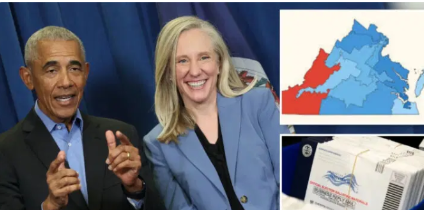
A judge in Virginia has struck down a voter-approved redistricting measure and halted the certification of election results, concluding that the amendment violated several provisions of the state constitution. The decision was issued in a final judgment on April 22 by the Tazewell County Circuit Court.
Judge Jack Hurley ruled that both the proposed constitutional amendment and the legislative process used to advance it were “void ab initio,” meaning they were legally invalid from the very beginning. As part of his ruling, he directed state officials not to certify the results of the April 21 special election and to refrain from taking any action to implement new congressional district maps.
This decision effectively invalidates the votes cast in the referendum, even though early results showed a narrow majority of voters supported the measure. The ruling also establishes a permanent injunction, preventing election officials from modifying voter registration records, redrawing precinct boundaries, or conducting any future elections based on the proposed map.
The lawsuit was filed by Republican organizations along with two sitting members of Congress, who argued that the proposed redistricting plan would unfairly alter their districts. The court agreed that the challengers had legal standing and would suffer irreparable harm if the plan were put into effect.
Central to the case was the process required under Virginia’s constitution for approving amendments. State law mandates that any proposed constitutional amendment must pass through two separate sessions of the General Assembly, with an intervening general election for the House of Delegates. The court determined that this requirement had not been satisfied, noting that the next qualifying election would not occur until 2027. Such multi-step procedures are designed to ensure that significant constitutional changes are carefully considered over time rather than rushed through a single legislative cycle.
Judge Hurley also identified multiple procedural issues in how the amendment was advanced. Lawmakers introduced the measure during a 2024 special legislative session but exceeded the session’s authorized scope. Additionally, the timing of the election failed to meet constitutional standards. Virginia law requires at least a 90-day gap between legislative approval of an amendment and the start of voting. However, early voting began on March 6, less than 90 days after the amendment’s passage, which the court found to be a violation.
Another major concern was the wording of the ballot question. The judge described it as “flagrantly misleading,” stating that it did not accurately represent the amendment approved by lawmakers. Election law requires ballot language to clearly and accurately describe the proposal so voters can make informed decisions. When wording is found to be misleading or incomplete, courts have the authority to invalidate the measure.
The ruling underscores that legal challenges to election measures often depend more on whether proper procedures were followed than on the substance of the policy itself. Even if a proposal has voter support, failure to comply with constitutional and procedural requirements can render it invalid.
State officials opposed the lawsuit and attempted to have it dismissed, arguing that the case should not move forward. However, Judge Hurley rejected those arguments, denying motions to dismiss and overruling claims of immunity. He also declined to pause the ruling while an appeal is pursued, meaning the injunction will remain in place for now. Virginia’s Attorney General, Jay Jones, has indicated that he plans to appeal the decision.
The referendum in question involved a proposed constitutional amendment that would allow state legislators to redraw congressional district boundaries in the middle of the decade. Under existing law, redistricting in Virginia occurs once every ten years following the U.S. Census and is handled by a bipartisan commission.
If implemented, the plan would have reassigned many Virginia residents to different congressional districts, potentially changing which representatives speak and vote on their behalf in Congress. Based on past voting trends, analysts projected that 10 out of the state’s 11 districts would likely favor Democratic candidates under the new map.