The United States Supreme Court ruled that federal courts do not have the authority to review visa revocations in cases involving fraudulent marriages for immigration purposes. This means that the Department of Homeland Security will have the final decision in such matters. In a unanimous ruling, the Court clarified that while courts may review the government’s decision to deny a visa initially, they cannot intervene after the Department of Homeland Security has revoked a visa that was previously approved.
The ruling highlights the significant authority granted to the Department of Homeland Security over immigration decisions, particularly in cases involving visa approvals and revocations. It also signals how immigration laws may be enforced in the future, including policies connected to former President Donald Trump’s immigration agenda, which focused heavily on stricter enforcement and increased deportations.
Justice Ketanji Brown Jackson, who was appointed to the Court by former President Joe Biden, wrote the opinion for the unanimous Court. In her explanation, she described the statute as “a quintessential grant of discretion” to the Department of Homeland Security. Jackson emphasized that Congress intentionally provided broad authority to the agency. According to her opinion, Congress did not outline detailed conditions or criteria that would limit the Secretary of Homeland Security’s ability to revoke approved visa petitions. Nor did the law specify when or how the Secretary must exercise that authority.
The Court’s opinion explained that the context of the law reinforces the discretionary nature of Section 1155, the statute that allows the government to cancel an already approved visa petition. The justices pointed out that the law states the Secretary “may” revoke an approved visa petition “at any time” if the Secretary determines there is “good and sufficient cause.” Because the language gives the Secretary broad discretion, the Court concluded that federal courts cannot second-guess or review those revocation decisions.
The case before the Court, Bouarfa v. Mayorkas, involved Amina Bouarfa, a United States citizen who filed the lawsuit after her husband’s visa was revoked. Government officials determined that her husband had previously participated in a fraudulent marriage in order to obtain immigration benefits. Because immigration law treats such conduct as a serious violation, the Department of Homeland Security concluded that he was permanently ineligible for lawful permanent residency in the United States. As a result, the agency revoked the visa petition that had been approved based on his marriage to Bouarfa.
During oral arguments, the justices focused closely on the relevant immigration statute, which allows judicial review of initial visa denials but does not mention review of visa revocations. The Court interpreted this difference as a signal that Congress deliberately chose to give the Department of Homeland Security the final say in revocation decisions.
Chief Justice John Roberts noted during the proceedings that Bouarfa’s husband could attempt to restart the immigration process by submitting a new visa application. If that application were denied, the denial could potentially be challenged in court because initial visa denials are subject to judicial review. However, Bouarfa’s attorney, Samir Deger-Sen, argued that forcing families to restart the process creates serious hardship. According to him, the requirement to begin the application process again leads to long delays, emotional stress, and financial strain for families who are trying to remain together.
Immigration advocates expressed concern that the ruling could further complicate an already strained immigration system. The United States immigration courts currently face a backlog of more than three million cases, which has created long waiting periods for individuals seeking visas, asylum, or other forms of immigration relief. Activists warned that giving the Department of Homeland Security nearly complete authority over visa revocations could make it harder for immigrants to challenge government decisions and could increase uncertainty for families.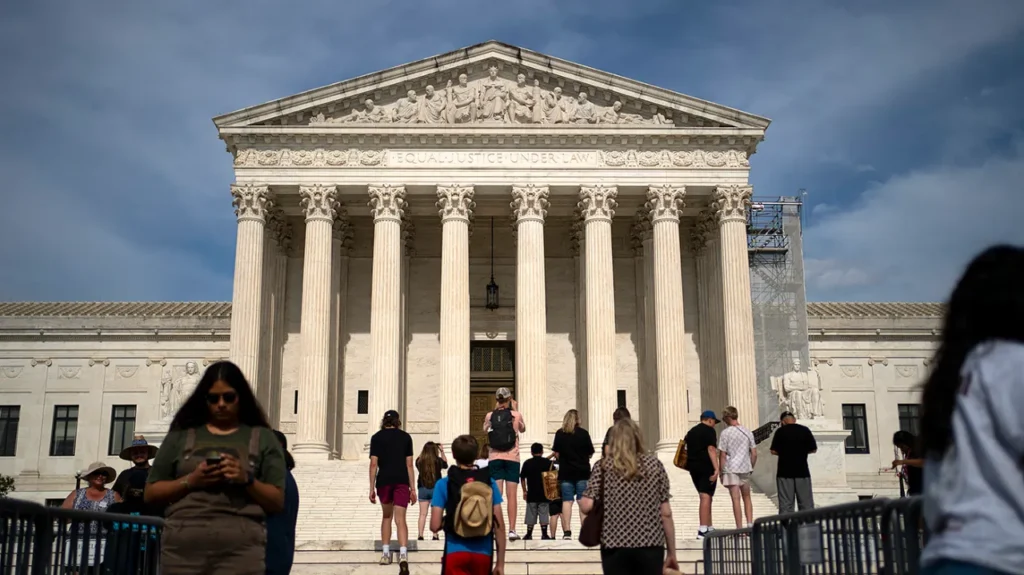
The ruling represents the second major immigration-related decision by the Supreme Court this month that favored the federal government. In another case, Urias-Orellana v. Bondi, the Court unanimously ruled that federal appeals courts must apply a highly deferential standard when reviewing decisions made by the Board of Immigration Appeals regarding asylum claims.
Justice Ketanji Brown Jackson also wrote the opinion in that case. The ruling addressed how courts should review decisions about whether asylum seekers have experienced the level of persecution required to qualify for protection under United States immigration law.
The case involved Douglas Humberto Urias-Orellana, his wife Sayra Iliana Gamez-Mejia, and their child, who fled El Salvador in 2021. The family claimed they were escaping threats of violence from a hitman, known as a sicario, who had previously shot and killed two of Urias-Orellana’s half-brothers. Urias-Orellana stated that associates connected to this individual repeatedly demanded money from him and physically assaulted him during one encounter. Because of these threats, the family sought asylum in the United States.
Under the Immigration and Nationality Act, immigration judges must determine whether asylum applicants left their home countries because of persecution or a well-founded fear of persecution. The law specifies that the persecution must be connected to one of several protected grounds, including race, religion, nationality, political opinion, or membership in a particular social group.
In Urias-Orellana’s case, an immigration judge concluded that the family’s experiences did not meet the legal threshold required for asylum protection. The judge partly based this decision on the fact that the family had previously been able to avoid harm by relocating to another part of El Salvador. Because internal relocation was possible, the judge determined that the danger did not rise to the level required under the law.
After the ruling, Urias-Orellana and his family appealed the decision to the Board of Immigration Appeals. When the case eventually reached the federal courts, the Supreme Court was asked to decide how closely appellate courts should review the immigration board’s factual determinations.
In its decision, the Supreme Court ruled that the Immigration and Nationality Act requires courts of appeals to apply what is known as the “substantial evidence” standard. This standard is highly deferential to the immigration authorities. According to Justice Jackson’s explanation, courts can reverse the Board of Immigration Appeals only if, after reviewing the entire record, any reasonable adjudicator would be forced to reach the opposite conclusion.
Jackson acknowledged that the statute itself does not explicitly use the words “substantial evidence.” However, she explained that other phrases within the law effectively limit the scope of judicial review. For example, Section 1252(b)(4)(B) states that administrative findings of fact must be treated as conclusive unless a reasonable adjudicator would be compelled to conclude otherwise.
By emphasizing this standard, the Court reinforced that immigration authorities have significant power when determining asylum eligibility. Together, the two rulings underscore the broad discretion granted to federal immigration agencies and the limited ability of courts to overturn those decisions.